Specialised Astro Cameras
CMOS Cameras
Our main cameras are CMOS cameras developed specifically for astrophotography. For deep-sky imaging we use two QHY 600Ms, which offer, among other things, a full-frame sensor, very high quantum efficiency, very low readout noise, and a very low dark current. For these cameras we also have an off-axis guider, one filter wheel with 9 positions, and one filter wheel with 7 positions.
A QHY 268M serves as the main camera for our two spectrographs. We also have a veTEC 533C from Omegon and a range of guiding and planetary cameras. These are used primarily for solar observations or as guiding cameras (see e.g. here) in combination with the QHY 600M and the spectrographs.
We have dedicated a separate article to the assembly of some of the cameras.


Main Cameras
| QHY 600M | QHY 268M | veTEC 533C | |
| Model number | QHY 600M PRO-L | QHY 268M-PH | Omegon Pro veTEC 533C |
| Pixel size | 3.76 $\mu \text{m}$ x 3.76 $\mu \text{m}$ | 3.76 $\mu \text{m}$ x 3.76 $\mu \text{m}$ | 3.76 $\mu \text{m}$ x 3.76 $\mu \text{m}$ |
| Number of pixels | 9576 x 6388 (9600 x 6422 with overscan) | 6252 x 4176 (6280 x 4210 with overscan) | 3008 x 3008 |
| Total chip size | 36 mm x 24 mm | 23.45 mm x 15.7 mm | 11.3 mm x 11.3 mm |
| High Conversion Gain (HCG) | Photographic DSO Mode (#0): 26, High Gain Mode (#1): 56 | 101? (not published) | |
| Max. ADC bit depth | 16 bit | 16 bit | 14 bit |
| Field of view with CDK20 | 35.8' x 23.4' | 23.3' x 15.6' | 11.2' x 11.2' |
| Sampling | 4.5 pixels per arcsec | 4.5 pixels per arcsec | 4.5 pixels per arcsec |


Planetary/Guiding Cameras
| Model | Model number | Number of pixels | Pixel size [µm] | Chip size [mm] | HCG | Bit depth (native) | Readout noise [$\text{e}^-$] | FPS | Peak QE [%] |
|---|---|---|---|---|---|---|---|---|---|
| QHY 485C | QHY-5-III-485C | 3864 x 2180 | 2.9 | 11.2 x 6.3 | - | 8 & 16 (12) bit | 0.77 - 2.4 | 44 @ 8 bit | > 90 |
| QHY 462C | QHY-5-III-462C | 1920 x 1080 | 2.9 | 5.6 x 3.2 | 100 | 8 & 16 (12) bit | 0.5 - 2.6 | 135 @ 8 bit | > 90 |
| ZWO ASI174 | ZWO ASI174MM Mini Mono | 1936 x 1216 | 5.86 | 11.3 x 7.1 | - | 10 & 12 (12) bit | 3.5 - 6.0 | 128 - 164 @ 12 or 10 bit | 77 |
| ZWO ASI220 | ZWO ASI220MM Mini Mono | 1920 x 1080 | 4 | 7.68 x 4.32 | 106 | 8 & 16 (12) bit | 0.6 - 3.2 | 7 - 14 @ 16 or 8 bit | 92 |
| ZWO ASI678 | ZWO ASI678MM | 3840 x 2160 | 2 | 7.7 x 4.3 | 182 | 12 bit | 0.6 - 3.5 | 47.5 @ 12 bit? | 83 |
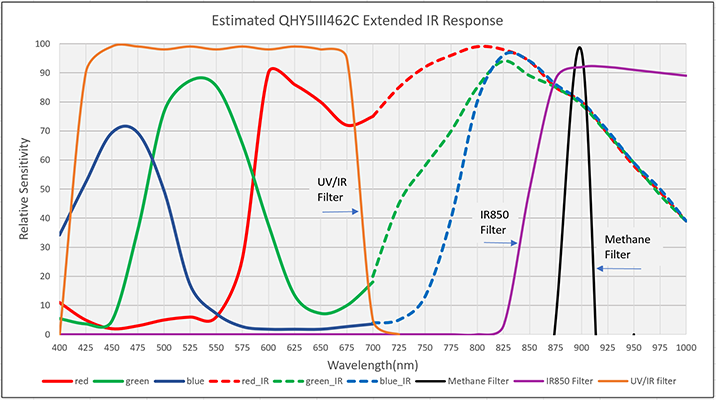
Note: The QHY 462C has a high quantum efficiency in the red to near-infrared range, making it particularly interesting for planetary observations. In addition to the usual UV/IR filters, we have for this camera an IR850 filter that transmits only near-infrared light, as well as a relatively narrow-band methane filter around 880 nm.
Filter Wheels
QHY 600M
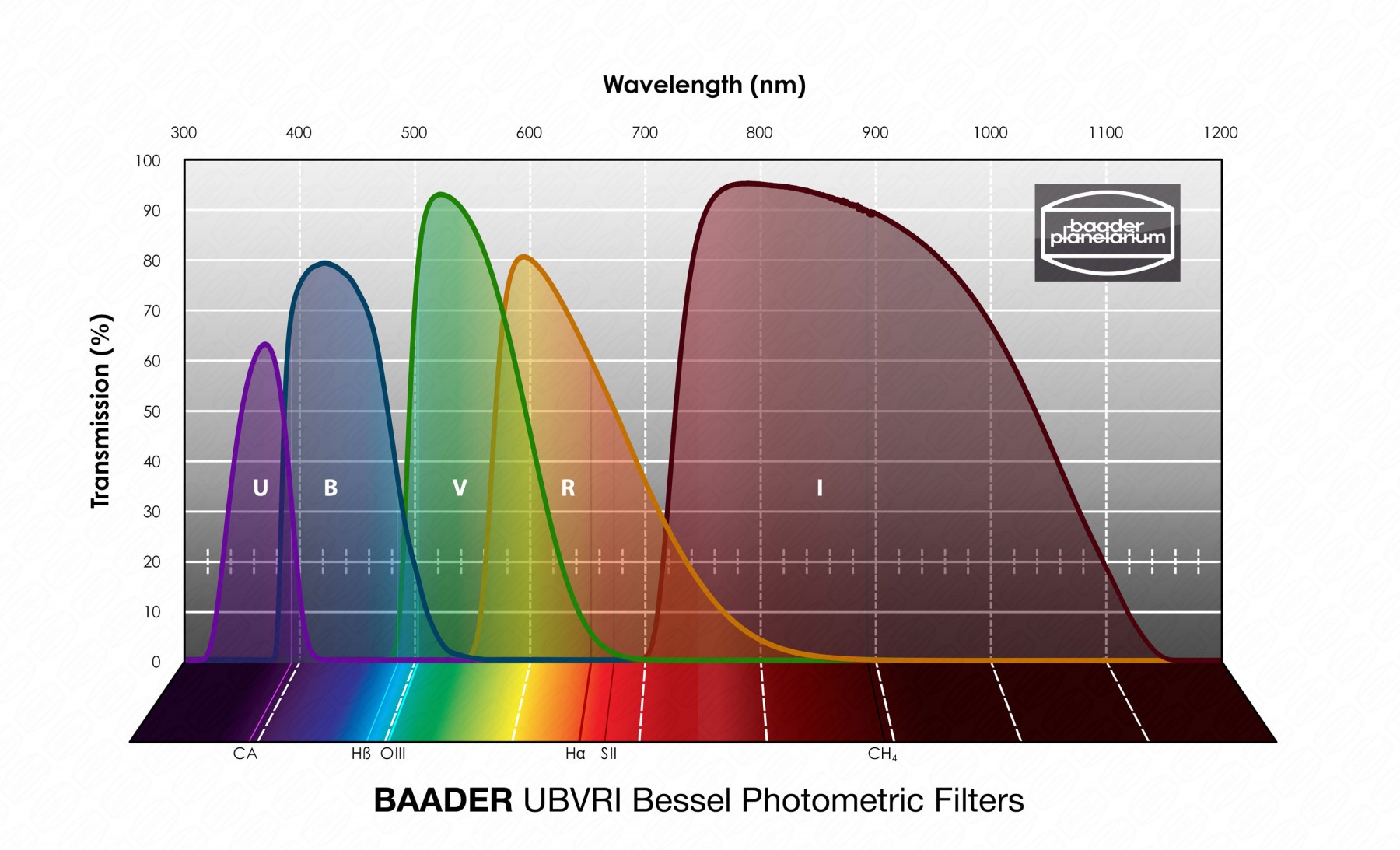
For the QHY 600Ms we have two filter wheels. The first is a QHY CFW3-XL with the following Bessel filters:
| Filter position | 1 | 2 | 3 | 4 | 5 | 6 | 7 | 8 | 9 |
|---|---|---|---|---|---|---|---|---|---|
| Filter | H_alpha | OIII | SII | U | B | V | R | I | Clear |
| Comment | Narrowband | Narrowband | Narrowband | Broadband | Broadband | Broadband | Broadband | Broadband |
The transmission curves of the UBVRI filters can be found on the Baader Planetarium website: Filter transmission. The filter curves of the narrowband filters are similar to those of the STF-8300.
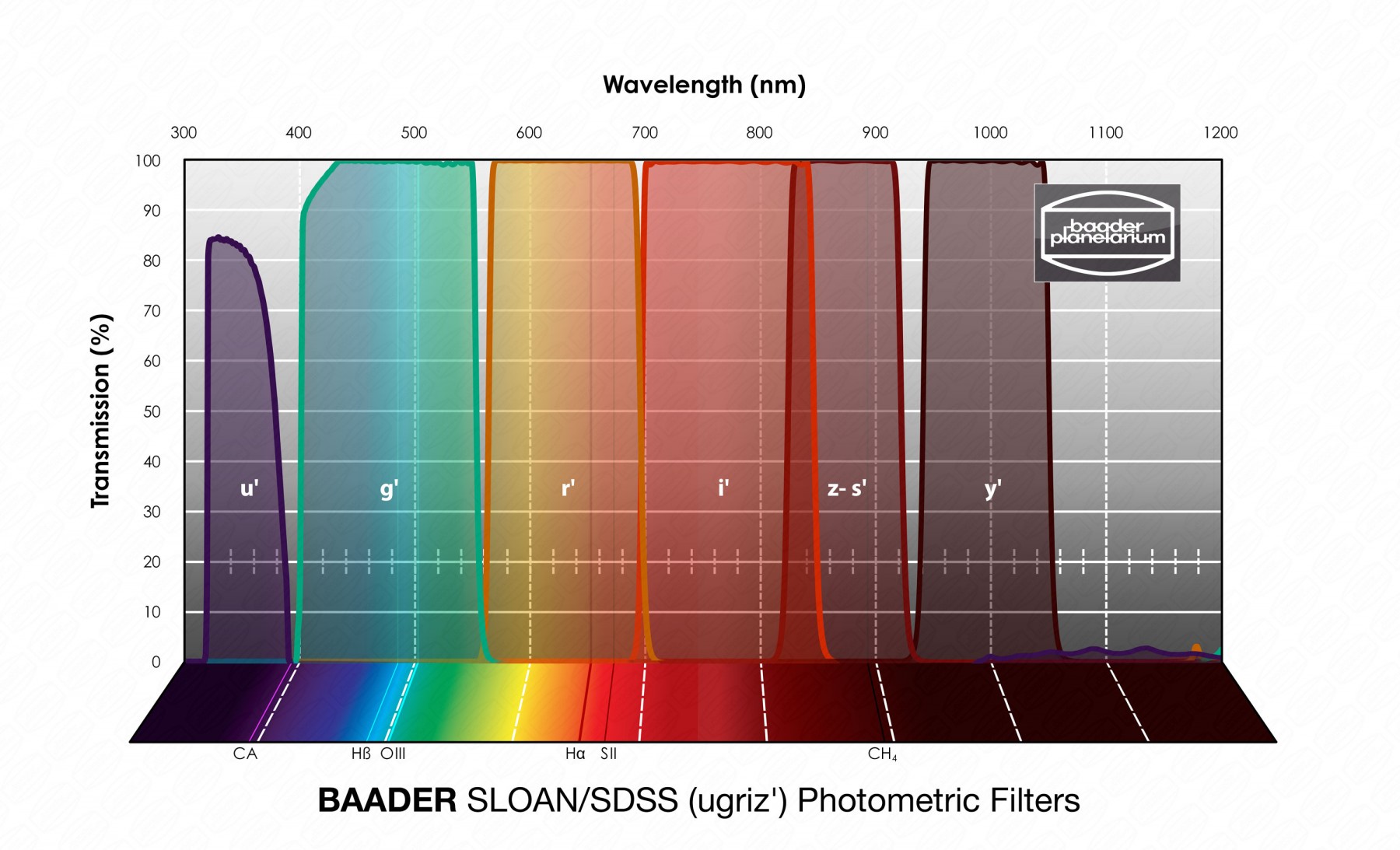
The second is a QHY CFW3-L with the following SLOAN/SDSS filters:
| Filter position | 1 | 2 | 3 | 4 | 5 | 6 | 7 |
|---|---|---|---|---|---|---|---|
| Filter | u' | g' | r' | i' | z-s' | y' | Clear |
| Comment | Broadband | Broadband | Broadband | Broadband | Broadband | Broadband |
The transmission curves of the ugriz' filters can be found on the Baader Planetarium website: Filter transmission.
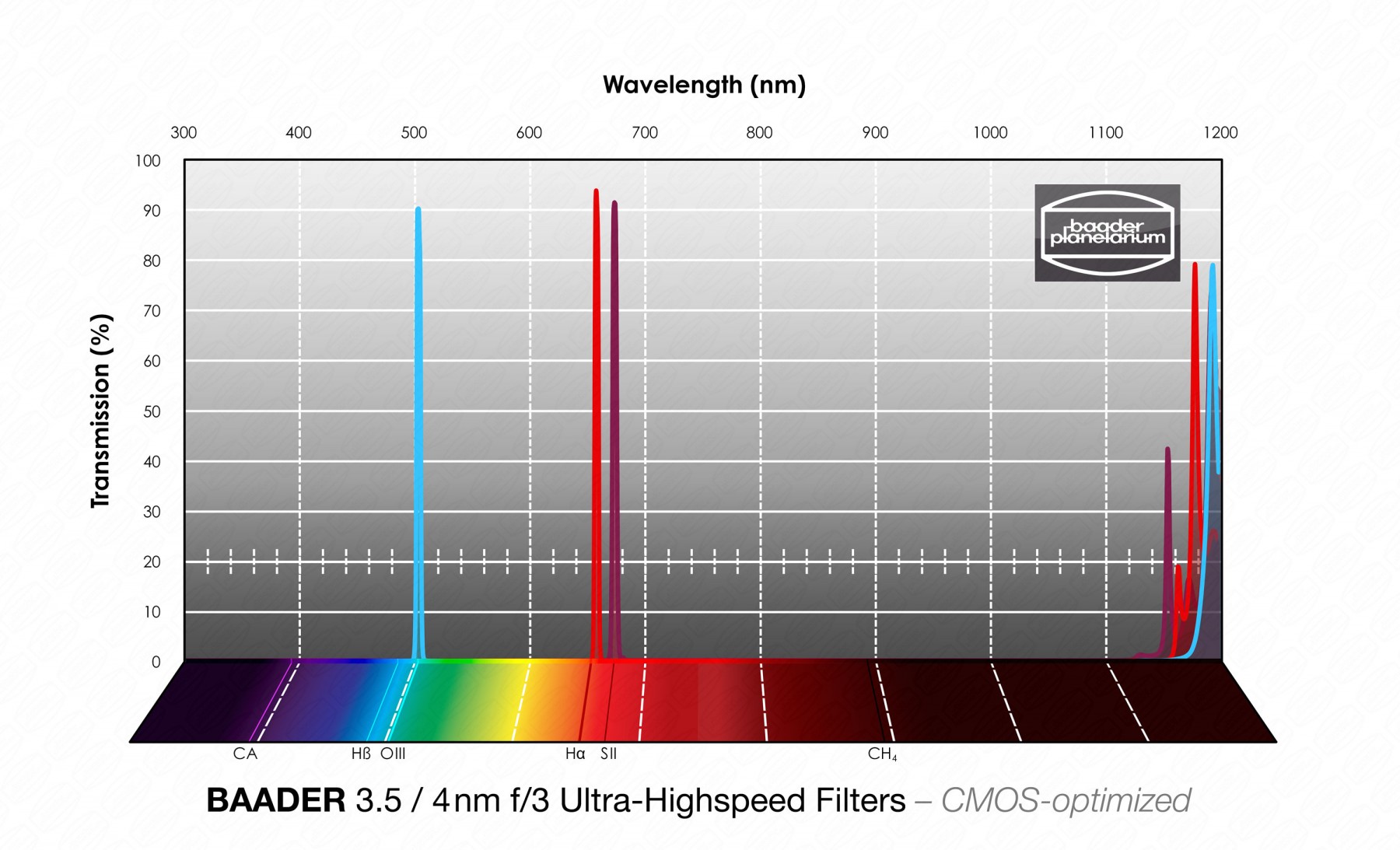
We also have a UFC filter changer system for our RASA 11 V2, which can be fitted with 50 mm x 50 mm square filters. We currently have a complete set of SLOAN/SDSS filters (see above) and H-alpha, O-III, S-II Ultra Highspeed filters.
CCD Cameras
In addition, four older CCD cameras (ST-7, ST-8, STF-8300M, ST-i) from SBIG (Santa Barbara Instrument Group) and one CCD camera (Skyris 445C) from Celestron are available.
The ST-7, ST-8, and STF-8300M are deep-sky cameras, although they are now rarely used due to their relatively small field of view. The ST-i and the Skyris 445C are “planetary cameras” that allow very short exposure times.
All cameras can be controlled via Maxim DL.


Technical Data
| ST-7 | ST-8 | STF-8300 | Skyris 445 | SBIG ST-i | |
|---|---|---|---|---|---|
| Model number | ST-7XME-D | ST-8XME | STF-8300M | Skyris 445C | ST-i Monochrome |
| Pixel size [µm] | 9 | 9 | 5.4 | 3.75 | 7.4 |
| Number of pixels | 765 x 510 | 1530 x 1020 | 3326 x 2504 | 1280 x 960 | 648 x 486 |
| Total chip size [mm] | 6.9 x 4.6 | 13.8 x 9.2 | 17.96 x 13.52 | 6.26 x 5.01 | 4.8 x 3.6 |
| Field of view with CDK20 ['] | 6.9 x 4.6 | 13.7 x 9.2 | 17.9 x 13.5 | 6.2 x 5.0 | 4.8 x 3.6 |
| Sampling [pixels/''] | 1.9 | 1.9 | 3.1 | 3.4 | 2.3 |
Filter Wheels
ST-7 & ST-8
A filter wheel with the following filters can be attached to the ST-7 and ST-8:
| Filter position | 1 | 2 | 3 | 4 | 5 | 6 | 7 | 8 | 9 | 10 |
|---|---|---|---|---|---|---|---|---|---|---|
| Filter | U | B | V | R | I | H_beta | H_alpha | UHC-S | OIII | EMPTY |
| Comment | Broadband | Broadband | Broadband | Broadband | Broadband | Narrowband | Narrowband | Narrowband | Narrowband |
The transmission curves of the UBVRI filters can be found on the Baader Planetarium website: Filter transmission. The filter curves of the narrowband filters are similar to those of the STF-8300.

STF-8300
A filter wheel with the following filters is available for the STF-8300:
| Filter position | 1 | 2 | 3 | 4 | 5 | 6 | 7 | 8 |
|---|---|---|---|---|---|---|---|---|
| Filter | Block UV/IR (L) | Blue | Green | Red | H_alpha | OIII | V | B |
| Comment | Luminance | Broadband | Broadband | Broadband | Narrowband | Narrowband | Broadband | Broadband |
The transmission curves of the filters can also be found on the Baader Planetarium website: Filter transmission

The transmission curves of the V and B filters are identical to those in the ST-7 and ST-8 respectively.
Special Features
- An adaptive optics unit, the AO-7, can be placed in front of the ST-7 and ST-8, which can be used for guiding and optimising image quality (see e.g. here).
- In addition to the main imaging chip, the ST-7 and ST-8 contain a secondary guiding chip that allows the telescope to automatically track an object (see e.g. here) while the main CCD captures the actual images.
- The off-axis guiders of the STF-8300 and the QHY 600M have the advantage of being mounted in front of the respective filter wheel, meaning that guiding is independent of the guide star's brightness in the selected filter. As a result, fainter objects can be used as guide stars with these two cameras than is possible with the ST-7 or ST-8.
Maintenance
The desiccant cartridges of the cameras must be regenerated (baked out) at least every 12 months, otherwise there is a risk of ice forming on the cooled CCD sensors during winter. The desiccant cartridges of the ST-7 and ST-8 are located on the underside of the cameras and can be easily removed from the camera body with a screwdriver. This process is even simpler with the STF-8300, as the desiccant cartridge (mounted on the side) can simply be unscrewed by hand. The connection between the camera body and the desiccant cartridge is sealed with an O-ring, which unfortunately tends to slip off the cartridge and disappear into the camera's electronics. Care should therefore be taken here! To prevent unnecessary moisture accumulating inside the camera, the removed desiccant cartridge should be replaced with the dummy stored in the lab room. After four hours at 170 °C in a conventional oven (without the O-ring), the desiccant material inside the cartridges should be regenerated and ready to keep the cameras operational for another year.
DSLR
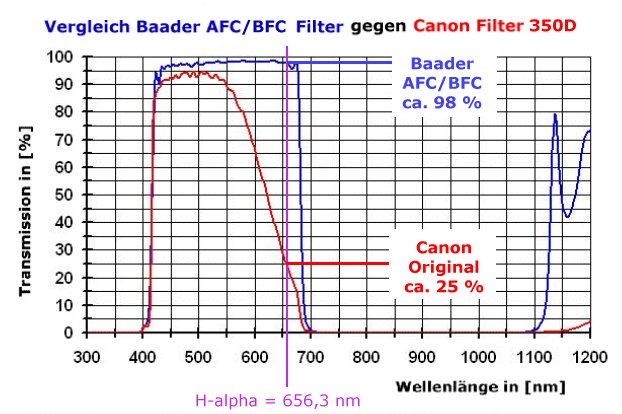
A Canon EOS 700D digital SLR camera is also available for short-exposure imaging and lucky imaging. This camera has been optimised for astrophotography by Baader through a replacement of the built-in filters. The transmission properties of the original Canon filter compared to the Baader filter can be seen in this image click (Baader Planetarium).
Technical Data


| EOS 700D | |
| Image sensor | CMOS sensor |
| Pixel size | 4.3 $\mu \text{m}$ x 4.3 $\mu \text{m}$ |
| Number of pixels | 5184 x 3456 |
| Total chip size | APS-C 22.3 $\text{mm}$ x 14.9 $\text{mm}$ |
| Crop factor and aspect ratio | 1.6 and 3:2 |
| Field of view with Celestron C14 | 19.6' x 13.1' |
| Field of view with Celestron C11 | 27.4' x 18.3' |
| Field of view with Celestron C11 + F/6.3 focal reducer | 43.5' x 29.0' |
| Field of view with Celestron C8 | 37.7' x 25.2' |
| Field of view with Celestron C8 + F/6.3 focal reducer | 59.9' x 40.0' |
| Exposure times | 30–1/4,000 $\text{s}$ (half or third stops) |
| ISO sensitivity | 100–12,800 (expandable to 25,600) |
Full HD video recording is also possible at a maximum ISO sensitivity of 6,400 (expandable to 12,800). The camera can be controlled via the tiltable and swivelling 7.7 cm LCD touchscreen or via a laptop. The continuous shooting speed is up to approximately 5 frames/s, maintained for approximately 22 shots (JPEG) or 6 shots (RAW).
It is also possible to control the camera remotely via computer.